High-Concept Plots: Make Your Story Hook Instantly

What is a high-concept plot?
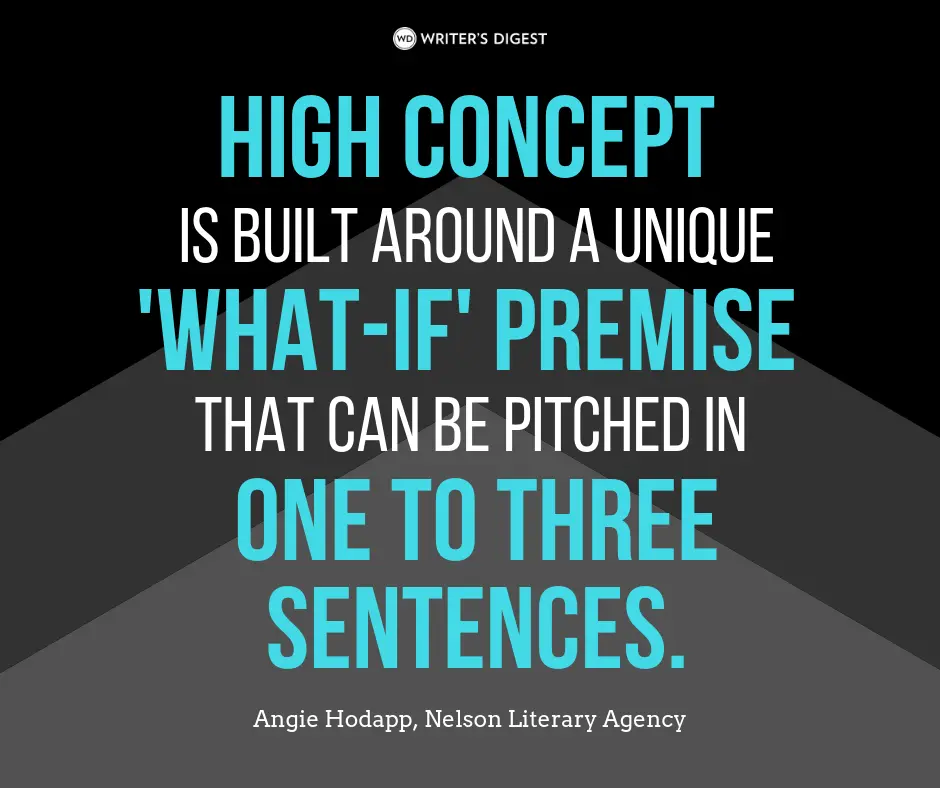
High-concept plots are easy to pitch, highly marketable story ideas driven by a simple, "what if" premise with immediate hook appeal. They are usually characterized by high stakes, broad commercial appeal, and a clear, often visual, central conflict that can be summarized in one or two sentences.
For example: What if we could clone dinosaurs? (Jurassic Park)
Before you know the characters, the island, or the science behind it, the premise already grabs the audience.
That is the power of a high-concept plot. The hook lands fast.
A strong high-concept idea often has:
A simple premise
A clear central conflict
High stakes
Broad appeal
A visual situation readers can picture right away
A twist on something familiar
It does not mean the story is shallow. A high-concept premise can still have deep characters, rich themes, and emotional weight.
Why are publishers looking for them?
Publishers like stories they can explain quickly.
That may sound blunt, but it matters. A book has to pass through a lot of hands before it reaches readers. An agent pitches it to an editor. An editor pitches it to an acquisitions team. The sales team talks about it to bookstores. Reviewers, booksellers, librarians, and readers all need a simple way to describe it.
A high-concept story travels well because the pitch is clear.
Examples:
The Hunger Games
A dystopian government forces teenagers to fight to the death on television.
The Handmaid’s Tale
A totalitarian society forces women into sexual servitude.
Die Hard
A cop fights terrorists in a skyscraper during a Christmas party.
The Matrix
A hacker learns his reality is actually a computer simulation.
Each of those can be explained fast. Each one also suggests conflict, tone, danger, and scale.
That is useful in a crowded market. Readers are choosing between endless books, shows, and movies. A sharp premise gives them a reason to pause.

How to Create a High-Concept Plot:
Ask a strong what if question
The question should create instant story pressure.
Try questions like:
What if a town forgot the same day every year?
What if a wedding planner had to plan the wedding of the person they love?
What if a child discovered the monsters under the bed were protecting the house?
What if a detective could solve murders only by speaking to the victim’s ghost for one minute?
The best “what if” questions suggest a problem, not just a situation. They make the reader wonder what will happen next.
Make it easy to pitch
The core idea should make sense quickly. It can be summarized in one or two sentences.
A useful pitch shape is:
When [main character] faces [strange or dangerous situation], they must [goal] before [stakes].
For example:
When a hacker learns the world is a simulation, he must choose whether to fight the machines controlling humanity.
That sentence gives us character, premise, conflict, and stakes.
Create high stakes and conflict
High-concept plots usually have strong, clear, and urgent stakes. That does not always mean the world must end. It means the outcome matters right away.
The stakes can be:
Type of stakes | Example |
Life or death | Kids are forced to fight in a televised arena. |
Freedom | A person must escape a controlling society. |
Identity | A character learns their entire reality is false. |
Love | Two people must fake a relationship and risk real feelings. |
Reputation | A public lie could destroy someone’s life. |
The bigger the gap between success and failure, the easier it is for readers to care.
Stakes work best when they are both external and personal. Saving the world is exciting. Saving the world while also confronting your deepest fear is better.
Try to visualize it
Many high-concept plots are easy to picture.
A dinosaur theme park. A death match on television. A cop in a skyscraper. A world made of code.
These ideas feel like posters or trailers because the central conflict has a strong visual shape. Readers can imagine the setting, the danger, or the main image almost instantly.
Think of an image that captures your premise:
A bride running from the wrong wedding
A haunted house that appears only during snowstorms
A chef cooking meals that reveal people’s memories
A courtroom where the dead can testify
If you can picture the story in one bold image, your concept may be getting sharper.
Consider genre blending
Yes, genre blending is one of the easiest ways to create a fresh high-concept idea.
You take something familiar, then add an unexpected twist.
For example, a romantic comedy about a woman forced to marry her boss for citizenship uses a familiar fake-relationship setup, but adds legal pressure, workplace tension, and a ticking clock.
You could try blending:
Romance plus survival story
Mystery plus time loop
Fantasy plus courtroom drama
Horror plus family reunion
Thriller plus cooking competition
The trick is to keep the pitch clean. If the blend takes too long to explain, simplify it.
How to TEST your high-concept plot
Before you rewrite your whole book, test the idea.
Ask yourself:
Can I pitch it in one sentence?
Does the premise create instant conflict?
Are the stakes clear?
Can a reader picture the main situation?
Does the idea feel familiar enough to understand but fresh enough to stand out?
Would someone want to hear more after one line?
Then try pitching it out loud to a friend. Do not explain the whole plot. Give them the short version.
If they ask questions like “How does that work?” or “What happens next?” that is a good sign.
If they look confused, your concept may need focus.
The best high-concept plots still need heart
A strong premise can open the door, but characters carry the story across the finish line.
Readers may pick up a book because of the hook, but they keep reading because they care about the people trapped inside that hook. So build the big idea, then ask what kind of character would suffer, grow, or change the most inside it.
That is where the story starts to feel alive.
A high-concept plot is not a shortcut. It is a promise. Make the promise simple, exciting, and clear. Then write the kind of story that delivers on it.


Comments